


[KoMiCo Lab] Surface Solution for High-Density Process Environments: ALD Coating
High hermeticity, excellent uniformity, and superior corrosion resistance are essential requirements for coatings used in advanced semiconductor fabrication. As device integration continues to intensify, the ability to reliably deposit ultra-thin films even within the complex internal structures of process equipment has become increasingly vital.
One of the most promising thin-film technologies that addresses these stringent demands is Atomic Layer Deposition (ALD) Coating.
ALD is an ultra-precise thin-film deposition technique capable of forming highly uniform and conformal coatings at the atomic scale. It utilizes self-limiting surface reactions by sequentially injecting two or more reactive precursors that chemically react only at the substrate surface. This controlled, layer-by-layer growth mechanism ensures exceptional film conformity, even on substrates with intricate topographies or high aspect ratios.

Key Characteristics of ALD Coating
- Excellent Conformality: Enables uniform and conformal film deposition on substrates with complex 3D geometries.
- Precise Thickness Control: Nanometer-scale film thickness can be controlled with atomic-level precision.
- Ultradense Film Structure: Provides superior chemical resistance against etching gases and plasma environments.
- Low Processing Temperature: Applicable to heat-sensitive components without thermal degradation.
These properties make ALD coating an essential solution across a broad range of high-tech industries, including semiconductors, displays, and batteries.
■ What is EGB Coating?
KoMiCo has developed EGB (Etch Gas Barrier) Coating, a premium surface protection solution optimized for semiconductor equipment, based on its expertise in Atomic Layer Deposition (ALD) technology.
In semiconductor manufacturing equipment, repeated process cycles gradually lead to the accumulation of thin film residues, reaction by-products, and particulate contaminants on critical internal components—such as chamber walls, gas lines, and shower heads. To remove these contaminants, in-situ cleaning methods are employed, which use activated plasmas or etching gases without disassembling the equipment.
Highly reactive fluorine-based etching gases such as NF₃, CF₄, and SF₆ play a key role in this process by chemically removing residues and restoring internal surfaces to a clean state.
However, this environment can cause severe degradation of internal components—particularly aluminum (Al)-based parts, which are commonly used in shower heads and gas distribution lines. When exposed to fluorine plasma, aluminum reacts readily to form unstable aluminum fluoride (AlFₓ) compounds. These layers are prone to micro-delamination or fragmentation over time, leading to particle contamination, non-uniform film deposition, extended seasoning time, and ultimately reduced equipment lifetime.
KoMiCo’s EGB Coating addresses these challenges at their root. By forming a high-density Al₂O₃ thin film layer on component surfaces, the coating acts as a robust barrier that suppresses direct chemical reactions between the substrate and the etching gases. This effectively prevents the formation of unstable reaction layers and minimizes the risk of particle generation or surface damage during in-situ cleaning.
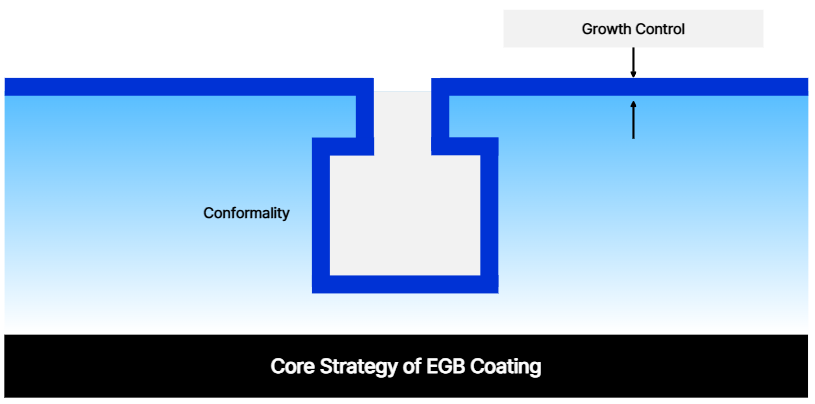
The core function of EGB coating lies in its ability to proactively suppress the formation of undesirable aluminum fluoride (AlFₓ) reaction layers during semiconductor processes. By stabilizing the surface chemistry of aluminum components, the coating significantly reduces the possibility of particle generation, leading to a notable decrease in process contamination and product defect risks.
Because chemical instability is minimized at the early stages of the process, initial variability is reduced, resulting in shorter seasoning times and faster equipment readiness. This directly contributes to improved production efficiency. At the same time, as the surface reactivity of aluminum is controlled, the uniformity of film thickness is enhanced, supporting better stability in deposition range over extended operation cycles.
EGB coating can be uniformly applied even to parts with narrow inner diameters and complex geometries. It enables stable and conformal coverage deep inside intricate components such as shower heads and gas lines used in CVD processes, without compromising structural precision.
Moreover, the coating induces a visible color change before and after application, allowing easy visual verification of coating presence and quality. This visual differentiation improves quality assurance efficiency in both manufacturing and maintenance environments.
These advantages demonstrate that EGB coating is a high-uniformity, high-density, and high-durability thin-film technology capable of meeting the practical demands of various semiconductor equipment components.
KoMiCo remains committed to advancing its precision surface coating technologies to keep pace with the evolving needs of the semiconductor industry, continuously delivering optimized and reliable solutions for customers worldwide.
<About KoMiCo>
KoMiCo, established in 1996, was the first company in Korea to commercialize cleaning and coating services for semiconductor equipment components. With global operations spanning the United States, China, Taiwan, and Singapore, KoMiCo has earned quality certifications from some of the world’s leading semiconductor manufacturers, solidifying its position as a Global No.1 in the industry.
Building on its advanced cleaning and coating technologies, KoMiCo continues to enhance its core business while expanding into the development and supply of key OEM components for semiconductor equipment. Moving forward, the company remains committed to improving customers’ productivity and yield, and aims to become a global leader in the semiconductor component cleaning, coating, and manufacturing industry.


