


[KoMiCo Lab] Dissolution-Based Cleaning Technology for Advanced Semiconductor Processes
In industries such as semiconductors, displays, and precision components, even the slightest contamination can lead to product defects. As a result, the importance of cleaning semiconductor parts is becoming increasingly critical.
In this article, we introduce dissolution-based cleaning technology, one of the key methods used for semiconductor part cleaning. This approach removes contaminants by selecting a solvent based on the chemical properties of the contaminant and dissolving the residue directly.
The fundamental principle behind dissolution cleaning is “like dissolves like” — substances with similar molecular characteristics tend to dissolve in each other.
In other words, polar contaminants dissolve well in polar solvents, while non-polar contaminants dissolve better in non-polar solvents. By leveraging this molecular affinity, the interaction between solvent and contaminant can be maximized, resulting in improved cleaning efficiency and effective surface decontamination.
■ Quantitative Approach Using Hansen Solubility Parameters (HSP)
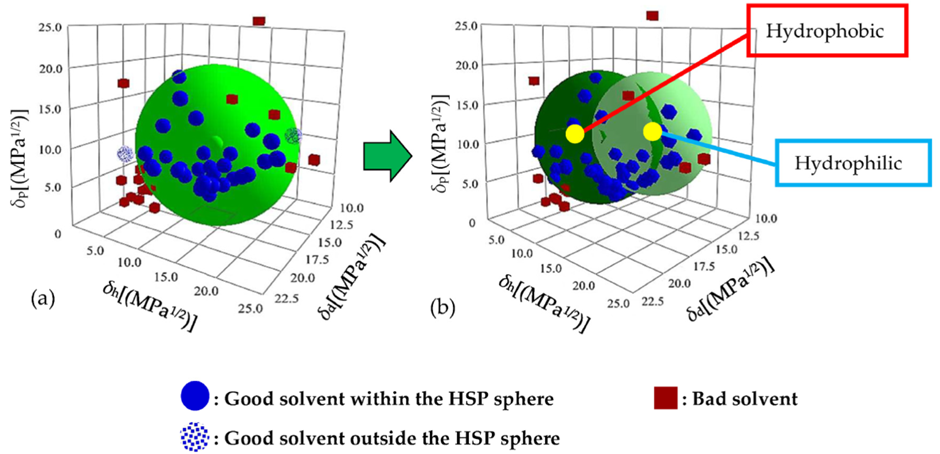
To quantitatively analyze molecular affinity, the Hansen Solubility Parameter (HSP) model is employed. As a core theoretical framework in dissolution-based cleaning technology, the HSP model is used to predict the chemical interactions and solubility potential between solvents and contaminants or polymers.
δt = √(δd² + δp² + δh²)
- δd : dispersion bonding contribution
- δp : polar bonding distribution
- δh : hydrogen bonding distribution
The combination of these three parameters allows for the calculation of the total solubility parameter, δt. The smaller the difference in δt values between two substances, the higher their mutual solubility is expected to be.
This parameter is widely used not only to predict solvent–solvent compatibility, but also to evaluate solvent–polymer solubility, making it a valuable tool in formulating effective cleaning solutions.
■ Solvent Compatibility Assessment Using the Aniline Point
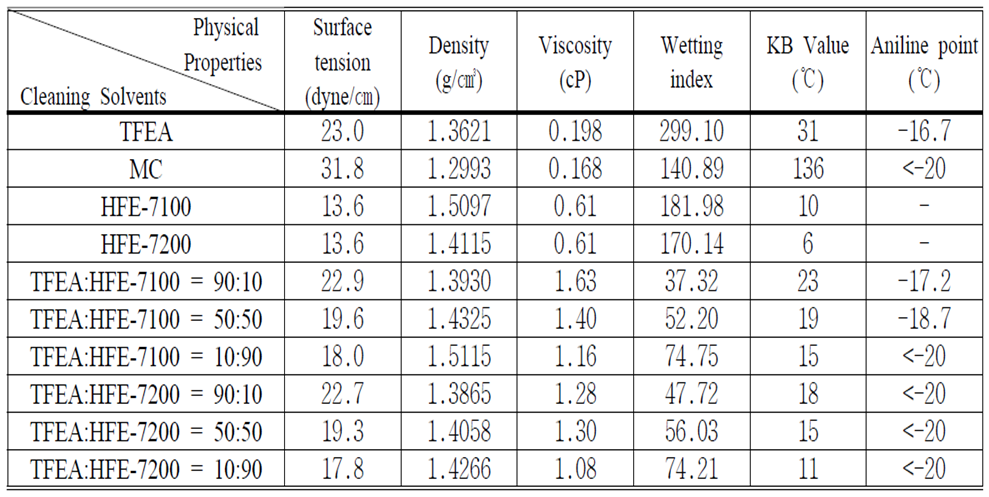
In addition to HSP analysis, the aniline point is often used to evaluate the mutual solubility of hydrocarbon-based solvents.
The aniline point refers to the temperature at which a sample, when mixed in equal volume with aniline and cooled, begins to show turbidity due to phase separation. It is an empirical indicator of a solvent’s solubility characteristics.
A lower aniline point generally indicates higher polarity of the solvent. Conversely, when two solvents exhibit similar aniline points, they are more likely to be mutually miscible and form a stable mixture.
Accordingly, in formulations that involve multiple organic solvents, the aniline point serves as a qualitative guideline for designing solvent ratios and assessing the stability of the mixture.
KoMiCo conducts both theoretical analysis and data-driven technology development to effectively address a wide range of organic contaminants that arise in semiconductor manufacturing processes.
By applying quantitative and qualitative evaluation methods—such as Hansen Solubility Parameter (HSP) analysis and Aniline Point measurement—KoMiCo precisely characterizes the chemical properties of contaminants and process conditions. Based on this understanding, we design customized cleaning solutions that optimize process performance and maximize cleaning efficiency.
In the next article, we will introduce Sonication cleaning technology. Stay tuned!
<About KoMiCo>
KoMiCo, established in 1996, was the first company in Korea to commercialize cleaning and coating services for semiconductor equipment components. With global operations spanning the United States, China, Taiwan, and Singapore, KoMiCo has earned quality certifications from some of the world’s leading semiconductor manufacturers, solidifying its position as a Global No.1 in the industry.
Building on its advanced cleaning and coating technologies, KoMiCo continues to enhance its core business while expanding into the development and supply of key OEM components for semiconductor equipment. Moving forward, the company remains committed to improving customers’ productivity and yield, and aims to become a global leader in the semiconductor component cleaning, coating, and manufacturing industry.


